Cloonakilla NS Bí Cineálta Policy
Bí Cineálta Policy to Prevent and Address Bullying Behaviour
The Board of Management of Cloonakilla NS has adopted the following policy to prevent and address bullying behaviour.
This policy fully complies with the requirements of Bí Cineálta: Procedures to Prevent and Address Bullying Behaviour for Primary and Post-Primary Schools 2024.
The board of management acknowledges that bullying behaviour interferes with the rights of the child as set out in the United Nations Convention on the Rights of the Child. We all, as a school community, have a responsibility to work together to prevent and address bullying behaviour and to deal with the negative impact of bullying behaviour.
We are committed to ensuring that all students who attend our school are kept safe from harm and that the wellbeing of our students is at the forefront of everything that we do. We recognise the negative impact that bullying behaviour can have on the lives of our students and we are fully committed to preventing and addressing bullying behaviour.
We confirm that we will, in accordance with our obligations under equality legislation, take all such steps that are reasonably practicable to prevent the harassment of students or staff on any of the nine grounds specified: gender, civil status, family status, sexual orientation, religion, age, disability, race and membership of the Traveller community.
It is very important to note that this policy is fully aligned with the ‘BÌ Cinealta: Procedures to Prevent and Address Bullying Behaviour for Primary and Post-Primary Schools’ and that it should be read in conjunction with the procedures.
| Guiding Vision The vision of the Board of Management of Cloonakilla NS is to provide an education system where every child and young person feels valued and is actively supported and nurtured to reach their full potential. To achieve this, all members of the school community need to work together to maintain an inclusive school environment where bullying is not tolerated and where individual differences are acknowledged, valued and celebrated. The primary aim in addressing reports of bullying behaviour should be to stop the bullying behaviour and to restore, as far as practicable, the relationships of the students involved, rather than to apportion blame. |
| Definition of Bullying Behaviour Bullying is defined as targeted behaviour, online or offline that causes harm. The harm caused can be physical, social and/or emotional in nature. Bullying behaviour is repeated over time and involves an imbalance of power in relationships between two people or groups of people in society. The detailed definition is provided in Chapter 2 of the Bí Cineálta procedures. Each school is required to develop and implement a Bí Cineálta policy that sets out how the school community prevents and addresses bullying behaviour. Strategies to deal with inappropriate behaviour that is not bullying behaviour are provided for within the school’s Code of Behaviour. The core elements of the definition are further described below: Targeted behaviour: Bullying is deliberate, unwanted behaviour that causes harm to others, and where the student displaying bullying behaviour knows that their behaviour is or will be perceived as harmful by the child or young person experiencing the behaviour. Bullying is not accidental or reckless behaviour. The harm can be physical (for example, personal injury, damage to or loss of property), social (for example. withdrawal, loneliness, exclusion) and/or emotional (for example, low self-esteem, depression, anxiety) and can have a serious and long-term negative impact on the student experiencing the bullying behaviour. If the repeated harm is real for the student experiencing the behaviour but unintended by the other student, this is not bullying but, importantly, must still be addressed under the school’s code of behaviour. Repeated behaviour: Bullying takes the form of a systematic pattern of behaviour which is repeated over time. Single offline incidents of intentional negative behaviour involving an imbalance of power are not considered bullying but must still be addressed under the school’s code of behaviour. Posting a single harmful message/image/video online, and which is highly likely to be reposted or shared with others can therefore be seen as bullying behaviour. Imbalance of power: In incidents of bullying, the student experiencing the bullying behaviour finds it hard to defend themselves as a result of the abuse of a real or perceived imbalance of power. This imbalance of power may manifest itself through differences in size, strength, age, ability, peer group power, economic status, social status, religion, race, ethnic origin including membership of the Traveller and/or Roma communities, sexual orientation, family circumstances, gender, gender identity, gender expression, experience of the care system, disability or the receipt of special education. In incidents of online (or cyber) bullying, the imbalance of power may relate to online anonymity, technical proficiency and possession of information/images/video, and the inability of the targeted student to remove offensive online material or escape the bullying. |
| Behaviour that is not Bullying Behaviour A one-off instance of negative behaviour towards another student is not bullying behaviour. However, a single hurtful message posted on social media can be considered bullying behaviour as it has a high likelihood of being shared multiple times and thus becomes a repeated behaviour. Disagreement between two students, or instances where students don’t want to be friends or to remain friends, is not considered bullying unless it involves deliberate and repeated attempts to cause distress, exclude or create dislike by others including deliberate manipulation of friendship groups. Some students with special educational needs may have social communication difficulties which may make them communicate their needs through behaviours that can hurt themselves or others. It is important to note that their behaviours are not deliberate or planned, but, in certain situations, they are an automatic response which they can’t control. Bullying behaviour that occurs outside of school As per the Bí Cinealta Procedures, a school is not expected to deal with bullying behaviour that occurs when students are not under the care or responsibility of the school. However, where bullying behaviour has an impact in school, schools are required to support the students involved. Examples of prohibited bullying behaviours that can occur outside of school (non-exhausted list): Bullying behaviour that occurs in the area immediately outside the school, the local shops and the wider local area. Bullying behaviour that occurs on the journey to and from school. Bullying behaviour that occurs in organised clubs and groups outside of school such as sports clubs. Online bullying (cyberbullying) behaviour, along with other types of bullying behaviour can cause significant harm and have a lasting impact on students who experience this behaviour. Access to technology means that online bullying behaviour can happen any time and that the student’s home is no longer a safe place. The nature of these technologies means that digital content can be shared and seen by a very wide audience almost instantly and the content is almost impossible to delete permanently. Requests to take no action A student reporting bullying behaviour may ask that a member of staff does nothing about the behaviour other than “look out” for them. The student may not want to be identified as having told someone about the bullying behaviour. They may feel that telling someone might make things more difficult for them. Where this occurs, it is important that the member of staff shows empathy to the student, deals with the matter sensitively and speaks with the student to work out together what steps can be taken to address the matter and how their parents will be informed of the situation. It is important that the student who has experienced bullying behaviour feels safe. Parents may also make schools aware of bullying behaviour that has occurred and specifically request that the school take no action. Parents should put this request in writing to the school or be facilitated to do so where there are literacy, digital literacy or language barriers. However, while acknowledging the parent’s request, schools have a right to act and may decide that, based on the circumstances, it is appropriate to address the bullying behaviour. |
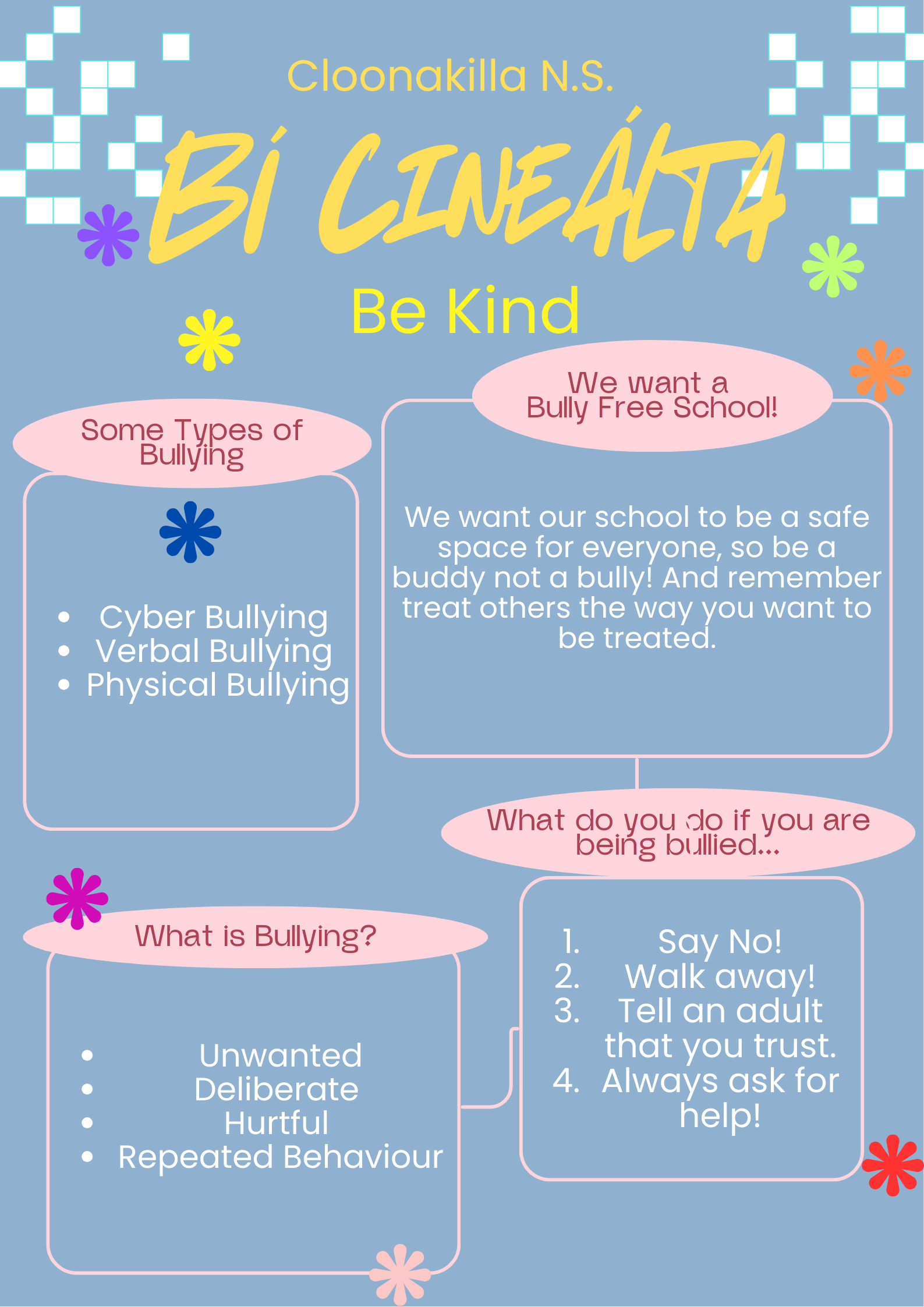
| How bullying behaviour occurs: Bullying behaviour can take many forms, which can occur separately or together. These can include the following, which is not an exhaustive list: Physical bullying behaviour: Physical bullying behaviour includes pushing, shoving, punching, kicking, poking and tripping students. It may also take the form of severe physical assault. While students can often engage in “mess fights” they can sometimes be used as a disguise for physical harassment or inflicting pain. Personal property can be a focus of attention for bullying behaviour. This may result in damage to clothing, mobile phone or other devices, schoolbooks and other learning material or interference with a student’s locker or bicycle. The contents of school bags and pencil cases may be scattered on the floor. Items of personal property may be defaced, broken, stolen or hidden. Verbal bullying behaviour: Continual namecalling directed at a student which hurts, insults or humiliates the student should be regarded as a form of bullying behaviour. Often namecalling of this type refers to physical appearance; for example, size or clothes worn or gender identity. It can also refer to a student’s accent, distinctive voice characteristics, academic ability, race or ethnic origin. Written bullying behaviour: Written bullying behaviour includes writing insulting remarks about a student in public places, passing around notes about or drawings of a student. Extortion: Bullying behaviour can involve extortion. Extortion is where something is obtained through force or threats. Indirect bullying behaviour: Exclusion: Exclusion bullying behaviour occurs where a student is deliberately and repeatedly isolated, excluded or ignored by a student or group of students. Relational: Relational bullying behaviour occurs when a student’s attempts to socialise and form relationships with peers are repeatedly rejected or undermined. Common forms include control: “Do this or I won’t be your friend anymore”; a group of students ganging up against one student; nonverbal gesturing; malicious gossip; spreading rumours about a student; giving a student the “silent treatment”; and the deliberate manipulation of friendship groups to make someone unpopular. Online bullying behaviour: Online bullying behaviour (cyberbullying) is carried out through the use of information and communication technologies such as text or direct messaging/instant messaging, social media platforms, e-mail, apps, digital gaming sites, gaming consoles, chatrooms and other online technologies. This form of bullying behaviour can include: sending or sharing nasty, insulting, offensive, and/or intimidating messages or images via text messages, emails, direct messages or other websites or apps posting information considered to be personal, private and sensitive without consent making and/or participating in fake profiles on a social network to impersonate and/or humiliate other students excluding or disrupting access to a student on purpose from online chat groups, access to accounts or from an online game Even though a message may be posted online just once by a student it can be considered bullying behaviour as it may be seen by a wide audience where it is intended to be shared or has a likelihood of being shared multiple times and is thus repeated. |
Section A: Development/review of our Bí Cineálta policy to prevent and address bullying behaviour
All members of our school community were provided with the opportunity to input into the development/review of this policy.
| Date consulted | Method of consultation | |
| School Staff | 14/04/2026 | Questionnaire |
| Students | 12/ 04/ 2026 | Student Survey Meeting with Student Council Development and communication of Student friendly version of policy |
| Parents | 14/04/2026 | Parent Survey |
| Board of Management | 20/04/2026 | BOM Meeting & Circulation of Policy |
| Wider school community as appropriate, for example, bus drivers | 17/04/2026 | Questionnaire |
| Date policy was approved: 20/04/2026 | ||
| Date policy was last reviewed: 12/06/2025 | ||
| Section B: Preventing Bullying Behaviour This section sets out the prevention strategies that will be used by the school. These include strategies specifically aimed at preventing online bullying behaviour, homophobic and transphobic bullying behaviour, racist bullying behaviour, sexist bullying behaviour and sexual harassment as appropriate (see Chapter 5 of the Bí Cineálta procedures): |
| The school has the following supervision and monitoring policies in place to prevent and address bullying behaviour (see Chapter 5 of the Bí Cineálta procedures): |
| Section C: Addressing Bullying Behaviour The primary aim in addressing reports of bullying behaviour should be to stop the bullying behaviour and to restore, as far as practicable, the relationships of the students involved, rather than to apportion blame. The whole school community has a responsibility to prevent and address bullying behaviour, this includes the Patron, The board of Management, Staff, Students and parents. The teacher(s) with responsibility for addressing bullying behaviour is (are) as follows: Mainstream class teachers and SETs (where appropriate). The Principal/Deputy Principal will provide support and advice and will become involved where appropriate. When bullying behaviour occurs, the school will: Be fair and consistent with all partiesListen, support and reassure the student who is experiencing bullying or has witnessed bullyingSeek to ensure the privacy of those involvedConduct all conversations with sensitivityConsider the age and ability of those involvedListen to the views of the student who is experiencing bullying behavior as to how best to address the situationTake action in a timely mannerInform parents of those involved at an early stage |
| Procedures to determine if bullying behaviour has occurred |
| Stage 1 – Identifying if bullying behaviour has occurred When identifying if bullying behaviour has occurred (Stage 1), teachers should consider what, where, when and why? as follows: Where one student is reported to be involved: the student should be engaged with individually at first. Thereafter, this student and the student who is reported to be experiencing the bullying behaviour should be met together. Each student should be asked for their account of what happened to ensure that everyone is clear about each other’s views If a group of students is involved each student should be engaged with individually at first. Thereafter, all students involved and the student who is reported to be experiencing the bullying behaviour should be met as a group. At the group meeting, each student should be asked for their account of what happened to ensure that everyone in the group is clear about each other’s views Each student should be supported as appropriate, following the group meeting. It may be helpful to ask the students involved to write down their account of the incident(s). |
| To determine whether the behaviour reported is bullying behaviour we will consider the following questions: Is the behaviour targeted at a specific student or group of students? Is the behaviour intended to cause physical, social or emotional harm? Is the behaviour repeated over time? If the answer to each of the questions above is Yes, then the behaviour is bullying behaviour, and the behaviour should be addressed using the BÌ Cineallta Procedures. If the answer to any of these questions is No, then the behaviour is not bullying behaviour. Strategies to deal with inappropriate behaviour are provided for within the school’s Code of Behaviour. (Note: One-off incidents may be considered bullying behaviour in certain circumstances. A single hurtful message posted on social media can be considered bullying behaviour as it has a high likelihood of being shared multiple times and thus becomes a repeated behaviour.) |
| Stage 2: Where bullying behaviour has occurred Where bullying behaviour has occurred the parents of the students involved will be contacted at an early stage to inform them of the matter and to consult with them on the actions to be taken to address the behaviour. It is also important to listen to the views of the student who is experiencing the bullying behaviour as to how best to address the situation. a record will be kept of the engagement with all involved.This record will include the form and type of behaviour if known, where/when it took place, and the date of the initial engagement with students involved and their parents. (This record will include the views of students and their parents regarding the actions to be taken to address bullying behaviour)The record will be shared with the Principal. NB: If the bullying behaviour is a child protection concern the matter will be addressed without delay in accordance with Child Protection Procedures for Primary and Post-Primary Schools. |
| Stage 3: Follow up where bullying behaviour has occurred: The teacher will engage with the students involved and their parents again within 20 school days after the initial engagement Important factors to consider as part of this engagement are the nature of the bullying behaviour, the effectiveness of the strategies used to address the bullying behaviour and the relationship between the students involved The teacher will document the review with students and their parents to determine if the bullying behaviour has ceased and the views of students and their parents in relation to this The date that it has been determined that the bullying behaviour has ceased will be recorded Any engagement with external services/supports will also be noted Ongoing supervision and support may be needed for the students involved even where bullying behaviour has ceased If the bullying behaviour has not ceased the teacher will review the strategies used in consultation with the students involved and their parents. A timeframe should be agreed for further engagement until the bullying behaviour has ceased If it becomes clear that the student who is displaying the bullying behaviour is continuing to display the behaviour, then the school’s consideration should be given to using the strategies to deal with inappropriate behaviour as provided for within the school’s Code of Behaviour. If disciplinary sanctions are considered, this is a matter between the relevant student, their parents and the school. If a parent(s) is not satisfied with how the bullying behaviour has been addressed by the school, in accordance with the Bí Cineálta Procedures to Prevent and Address Bullying Behaviour for Primary and Post-Primary Schools, they can refer to the school’s complaints procedures |
| It is important to note that the following supports are available to school staff to help them deal effectively with bullying behavior: NEPSOideWebwiseNational Parents CouncilTUSLA |
| Section D: Oversight The principal will present an update on bullying behaviour at each board of management meeting. This update will include the number of incidents of bullying behaviour that have been reported since the last meeting, the number of ongoing incidents and the total number of incidents since the beginning of the school year. Where incidents of bullying behaviour have occurred, the principal will also provide a verbal update which will include where relevant, information relating to trends and patterns identified, strategies used to address the bullying behaviour and any wider strategies to prevent and address bullying behaviour where relevant. This update does not contain personal or identifying information. See Chapter 7 of the Bí Cineálta procedures. This policy is available to our school community on the school’s website and in hard copy on request. A student friendly version of this policy is displayed in the school and is also available on our website and in hard copy on request. This policy and its implementation will be reviewed, following input from our school community, each calendar year or as soon as practicable after there has been a material change in any matter to which this policy refers. |
- Signed: T Cormican. Date: 20/ 04/ 2026 (Chairperson of board of management)
- Signed: K Kelly. Date: 20/ 04/ 2026 (Principal)
Student Friendly Version